
Quick answer
The refractory period is the recovery time after orgasm when a man cannot get another erection or orgasm. It ranges from a few minutes in younger men to hours or a day in older men. Its exact cause is uncertain, and no treatment reliably shortens it, but good general health, less alcohol and less pressure can help.
Key takeaways
- A refractory period is normal and lengthens gradually with age.
- Prolactin was long blamed, but newer research questions that theory.
- See a doctor for sudden changes or erection problems at other times.
After orgasm, most men find that their erection fades and that, for a while, further stimulation does not lead to another erection or orgasm. This recovery window is called the refractory period. It is a normal part of the sexual response cycle, but it varies a lot between people and changes with age, which leaves many men wondering whether theirs is “normal” and whether anything can shorten it. This guide explains what the research does and does not show.
What is the refractory period?
The refractory period is the time after orgasm during which a person cannot become fully aroused or reach orgasm again. In men it begins right after ejaculation. During this phase the penis usually becomes soft, and many men feel relaxed, satisfied or sleepy, and are less interested in sex for a time. Once the refractory period ends, arousal and erections can build again with stimulation.
Sex researchers describe sexual response in phases: excitement, plateau, orgasm and resolution. The refractory period sits within resolution, when heart rate, blood pressure and muscle tension return to their resting state.
How long does it last?
There is no single normal length. For some men it lasts only a few minutes; for others it lasts hours, or even a day or more. The same man may notice different recovery times on different occasions, depending on how aroused he is, how tired he is and the type of sexual activity.
Refractory period by age
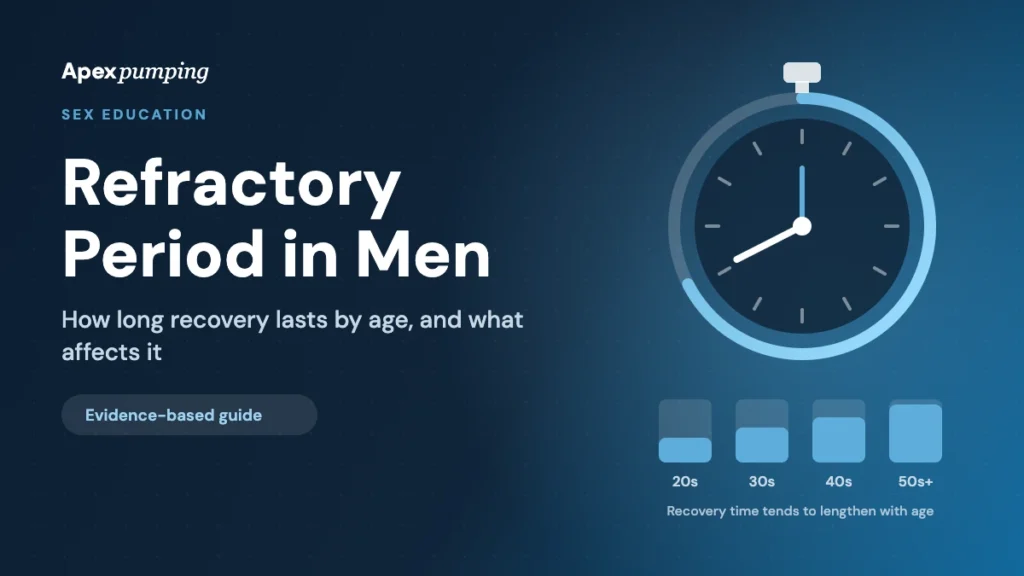
Age is the most consistent influence. Teenagers and men in their early twenties often recover within minutes. Recovery tends to lengthen gradually through the thirties and forties, and many men over 50 need several hours, sometimes until the next day. These are broad patterns rather than rules: a healthy, active older man may recover faster than a younger man with poor sleep, heavy drinking or untreated health problems.
Why do men have a refractory period?
Surprisingly, the exact mechanism is still not well understood.
- Prolactin: the hormone prolactin rises after orgasm in both men and women. A 2006 study found the rise was larger after intercourse than after masturbation, and a 2002 case report described a man who could reach orgasm repeatedly and showed no prolactin rise. These findings made prolactin a popular explanation.
- Newer evidence challenges that idea: a 2021 study in Communications Biology found that raising or blocking prolactin did not change the refractory period in male mice. Prolactin may be a marker of sexual satisfaction rather than the cause of the refractory period, although findings in mice do not automatically apply to people.
- Other proposed factors include changes in brain chemicals such as dopamine and serotonin, and feedback from the nervous system after ejaculation. Researchers have not settled on a single explanation.
Do women have a refractory period?
Women’s experiences after orgasm are more varied. Many women can continue to be aroused and may have further orgasms soon afterwards, while others find the clitoris temporarily too sensitive for more stimulation, which can act like a refractory period. Research on women’s post-orgasm experiences is limited.
What affects the length of the refractory period?
- Age, as described above.
- General health: cardiovascular fitness, weight, diabetes and hormone levels all influence sexual function.
- Sleep, stress and fatigue.
- Alcohol and recreational drugs, which can dull arousal and erections.
- Medicines, including some antidepressants and blood pressure treatments.
- Arousal and novelty: high arousal, a new setting or different types of stimulation can make a difference for some men.
Can you shorten your refractory period?
You cannot switch the refractory period off, and there is no proven treatment designed specifically to shorten it. Some approaches may help indirectly:
- Look after your overall health: regular exercise, a healthy weight, enough sleep, limited alcohol and not smoking support erections and recovery.
- Change the focus: continuing intimacy with touch, kissing or other forms of pleasure after orgasm keeps connection going while your body recovers, and some men find arousal returns sooner without pressure.
- Try pelvic floor exercises: stronger pelvic floor muscles support erectile function and ejaculatory control.
- ED medicines: some men report that PDE5 inhibitors such as sildenafil or tadalafil help them get a second erection sooner. Evidence is limited, and these medicines must only be used with a prescription and medical advice.
Be cautious about supplements or “prolactin blockers” sold online to shorten the refractory period. Evidence for them is weak, and some products contain undeclared medicines.
When is it worth seeing a doctor?
A refractory period that gradually lengthens with age is normal. It is worth speaking to a doctor if you notice a sudden change, if you have trouble getting or keeping an erection at other times, if your desire for sex has dropped noticeably, or if you have pain with ejaculation. These can be signs of an underlying issue such as erectile dysfunction, low testosterone or a medicine side effect.
Talking about it with a partner
Differences in recovery time are common in relationships. Explaining that the refractory period is a normal physical process, not a lack of desire, can take pressure off both partners. Many couples plan intimacy so that each partner’s pleasure is not tied to a single erection or orgasm.
Frequently asked questions
How long is a normal refractory period for men?
There is no single normal length. It can be a few minutes for some men and hours or even a day for others, and it usually gets longer with age.
Does the refractory period get longer with age?
Yes. Younger men often recover within minutes, while many men over 50 need several hours. Health, sleep and alcohol also affect recovery at any age.
Is prolactin the cause of the refractory period?
Not proven. Prolactin rises after orgasm, but a 2021 study found that changing prolactin levels did not alter the refractory period in male mice. The exact mechanism is still uncertain.
Can Viagra shorten the refractory period?
Some men report that PDE5 inhibitors such as sildenafil help them get another erection sooner, but evidence is limited. Only use these medicines with a prescription and medical advice.
Do women have a refractory period?
Women's experiences vary. Many can have further orgasms soon after the first, while others find the clitoris too sensitive for a while, which can act like a refractory period.
Sources & references
- The post-orgasmic prolactin increase following intercourse is greater than following masturbation (2006) — Biological Psychology (PubMed), November 15, 2026
- Absence of orgasm-induced prolactin secretion in a healthy multi-orgasmic male subject (2002) — International Journal of Impotence Research (PubMed), November 15, 2026
- No evidence for prolactin's involvement in the post-ejaculatory refractory period (2021) — Communications Biology (PMC), November 15, 2026
- Multiple Orgasms in Men – What We Know So Far (2016) — Sexual Medicine Reviews (PubMed), November 15, 2026
- Erectile Dysfunction (ED) – all sections — National Institute of Diabetes and Digestive and Kidney Diseases (NIH), November 15, 2026

Rob Editor, Apex Pumping
Rob is the editor of Apex Pumping, an independent research site about vacuum erection devices (VEDs) and LA Pump products. He compares manufacturer specifications, published clinical research and current checkout offers so readers can choose pumps, cylinders and accessories with realistic expectations. Rob is not a medical professional: health articles cite medical sources, and he encourages readers to talk to a doctor or urologist before starting vacuum therapy, especially with an existing condition or medication.