
Quick answer
Yes. Erectile dysfunction can often be treated without pills. Evidence-based options include lifestyle changes, pelvic floor muscle training, talking or sex therapy, vacuum erection devices, penile injections or urethral alprostadil, and penile implants. The right choice depends on the cause, your health and your preferences, so start with a medical check-up.
Key takeaways
- Guidelines say men should hear about every safe ED treatment, not just tablets.
- Pelvic floor training and lifestyle changes can improve mild ED.
- Shockwave, PRP and stem-cell treatments are still investigational.
Pills such as sildenafil and tadalafil are the best-known treatment for erectile dysfunction (ED), but they are not the only one, and they are not suitable for everyone. Some men cannot take them because of heart medication, some get side effects, and some simply prefer a different approach. Urology guidelines are clear that men should hear about every treatment that is safe for them, not just tablets, and that it is reasonable to start with whichever option fits their health, values and relationship. This guide walks through the evidence-based alternatives.
First, find out why ED is happening
ED is a symptom, not a diagnosis. Reduced blood flow, nerve damage, low testosterone, side effects of medicines, stress, anxiety and relationship difficulties can all play a part, often in combination. Because ED shares risk factors with heart disease, such as diabetes, high blood pressure, high cholesterol and smoking, a check-up is worthwhile even if you plan to avoid pills. Our guide to erectile dysfunction explains the common causes and what a doctor will usually check.
Lifestyle changes with real evidence
The same habits that protect the heart tend to protect erections. They will not work overnight, but they can improve mild ED and make every other treatment work better.
- Regular aerobic exercise: brisk walking, cycling or swimming most days supports blood-vessel health.
- Weight management: losing excess weight can improve erectile function, particularly around the waist.
- Stopping smoking: smoking damages the blood vessels that erections depend on.
- Limiting alcohol and avoiding recreational drugs.
- Managing diabetes, blood pressure and cholesterol with your doctor.
- Sleep: poor sleep and untreated sleep apnoea are linked with low testosterone and ED.
Pelvic floor muscle training
The pelvic floor muscles help keep blood in the penis during an erection. In a randomised controlled trial published in the British Journal of General Practice, men who did daily pelvic floor exercises with biofeedback, plus lifestyle advice, had better erectile function than men given lifestyle advice alone. Benefits are usually gradual and depend on doing the exercises correctly and consistently, so a session with a pelvic health physiotherapist is a good way to learn the technique.
Talking therapies and sex therapy
Performance anxiety, depression, stress and relationship conflict can cause ED or keep it going after a physical problem has improved. Cognitive behavioural therapy, psychosexual counselling and couples therapy address these directly and can be combined with physical treatments. Many men find that taking the pressure off penetrative sex for a while helps confidence return.
Vacuum erection devices
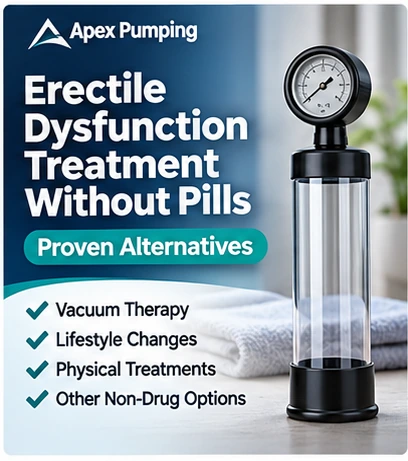
A vacuum erection device (VED) is a clear cylinder placed over the penis with a hand or battery pump that draws out air. The lower pressure pulls blood into the penis to create an erection, which can be maintained with a tension ring at the base. The American Urological Association recommends that men with ED be told about vacuum devices as a treatment option, including their benefits and burdens.
- Advantages: no medication, works regardless of nerve damage, reusable and can be combined with other treatments.
- Trade-offs: it takes practice, the erection can feel cooler and pivot at the base, and some men find the process interrupts intimacy.
- Safety: choose a device with a pressure-release valve, never leave a tension ring on for more than 30 minutes, and ask your doctor first if you take blood thinners or have a bleeding disorder.
Other prescription options that are not pills
If tablets do not suit you, there are non-oral medical treatments a urologist can prescribe:
- Penile injections (such as alprostadil) produce an erection within minutes and are highly effective for many men, including after prostate surgery.
- Urethral alprostadil is a small pellet inserted into the tip of the penis.
- Testosterone therapy may help only when blood tests confirm low testosterone.
Penile implants
An inflatable penile prosthesis is placed surgically inside the penis and inflated with a small pump in the scrotum when needed. It is usually considered when other treatments have not worked or are not acceptable. Satisfaction rates are generally high, but it is a permanent change that should be discussed carefully with an experienced surgeon.
Treatments still under investigation
Low-intensity shockwave therapy, platelet-rich plasma (PRP) and stem-cell injections are widely advertised. Professional guidelines currently treat them as investigational because the evidence is still limited, so be cautious about clinics promising cures and ask whether a treatment is being offered within a clinical trial.
Supplements and online “cures”
Herbal products sold for erections are not regulated like medicines, and some have been found to contain hidden prescription drugs. If you are considering a supplement, check it with a pharmacist or doctor, especially if you take heart medication.
How to choose
The right approach depends on the cause of your ED, your general health and what you and your partner are comfortable with. Many men use more than one option, for example lifestyle changes and pelvic floor training alongside a vacuum device or injections. A doctor or urologist can help you weigh the options and rule out underlying conditions.
Frequently asked questions
Can erectile dysfunction be treated without medication?
Yes, for many men. Lifestyle changes, pelvic floor training, talking therapies and vacuum erection devices all have evidence behind them, and non-oral prescription treatments such as injections are available if needed. The best option depends on the cause of your ED.
Do pelvic floor exercises really help erections?
They can. A randomised trial found that daily pelvic floor exercises with biofeedback improved erectile function compared with lifestyle advice alone. Results build gradually and depend on correct technique.
Are vacuum erection devices safe?
They are generally safe when used as directed. Use a device with a pressure-release valve, remove any tension ring within 30 minutes, and speak to a doctor first if you take blood thinners or have a bleeding disorder.
Does shockwave therapy cure ED?
Not proven. Professional guidelines currently class low-intensity shockwave therapy as investigational, so its long-term benefit is still uncertain.
When should I see a doctor about ED?
If ED lasts for more than a few weeks, is getting worse, or comes with other symptoms such as chest pain, reduced libido or pain, see a doctor. ED can be an early warning sign of heart disease or diabetes.
Sources & references
- Erectile Dysfunction: AUA Guideline (J Urol 2018) — American Urological Association, November 15, 2026
- Treatment for Erectile Dysfunction — National Institute of Diabetes and Digestive and Kidney Diseases (NIH), November 15, 2026
- Randomised controlled trial of pelvic floor muscle exercises and manometric biofeedback for erectile dysfunction — British Journal of General Practice (PubMed), November 15, 2026
- Reviewing the evidence for shockwave- and cell-based regenerative therapies in the treatment of erectile dysfunction — Therapeutic Advances in Urology (PMC), November 15, 2026
- External Penile Rigidity Devices – Class II Special Controls Guidance — U.S. Food and Drug Administration, November 15, 2026

Rob Editor, Apex Pumping
Rob is the editor of Apex Pumping, an independent research site about vacuum erection devices (VEDs) and LA Pump products. He compares manufacturer specifications, published clinical research and current checkout offers so readers can choose pumps, cylinders and accessories with realistic expectations. Rob is not a medical professional: health articles cite medical sources, and he encourages readers to talk to a doctor or urologist before starting vacuum therapy, especially with an existing condition or medication.